I’m part of a small group of foresight and foresight-adjacent practitioners that meets every month or so. Over time, I’ve noticed that our conversations tend to drift toward organizational challenges, and the degree to which teams or companies can ‘digest’ forward-facing insights or methods. This actually isn’t a new topic. In fact, over the years I’ve spent in this domain, I can’t remember when it wasn’t an issue. Whenever it comes up, however, I always find myself thrown off a bit — in part because I’m inherently suspicious of anything that hints at a “they-just-don’t-get-it” position, but also because something just doesn’t sit right with me about how this challenge manifests, especially when many organizations purport to value foresight insights highly.
This post is an attempt to take a step back, and to frame foresight within a broader historical and evolutionary perspective to better understand the contexts of how its insights are received. It’s rooted in my experience working in a design innovation consultancy, building and leading two corporate transformation / innovation teams, and time spent in big tech focusing on new product experimentation, foresight, and pathfinding. I’m not offering a prescriptive solution, but something I’ll call a pivot toward an appreciation of the partial. So, let’s get started.
Silver Bullets
The first thing I want to consider is the influence that trends have as they roll through the business landscape. Corporate America has an unquenchable thirst for “silver bullets”—magical, one-size-fits-all methodologies that promise to unlock hyper-growth, maximize efficiency, or crush the competition. When one company finds success with an approach, a booming industry of consultancies, books, and keynote speakers rapidly follows until seemingly every company is running the exact same playbook.
One of the most common of these spread through corporate America so pervasively that it’s now a stale trope: “No one ever got fired for hiring McKinsey.” The idea was that if someone needed a safe, justifiable outside view to absolve them of internal responsibility (or avoid a political quagmire), they could bring in McKinsey to make the hard calls. They were the “big guns” with big budgets who were hard to oppose in meetings. This tact eventually fell out of favor (or was exposed too often), and people fled to others — like Total Quality Management, Six Sigma, Business Process Reengineering, LEAN, Agile, and yes, even Human Centered Design (HCD).
In the case of HCD in particular, companies everywhere were clamoring to apply the approach to their every challenge. Stanford-ratified, and wrapped in boardroom buzz, “design thinking” activated empathy and elevated pattern identification to near-religious status. What began as an appreciation for how many designers think about product development rapidly expanded into a solution set aimed at everything from financial services to business models to broad-scale behavioral change. At the height of this fever pitch some of the top tier consultancies in the space wouldn’t even have a conversation with clients who weren’t ready to pony up at least 400 grand.
As the approach grew in popularity, many large organizations eventually grew weary of those high-priced consulting fees, and decided to build their own in-house design thinking teams. Transformation labs, studios, centers of excellence, and moonshot teams sprouted up everywhere as companies tried to inject a fast-moving, empathetic, and experimental innovation culture into often highly rigid, siloed, and bureaucratic organizations. What many eventually realized was that integrating insights from these initiatives proved highly challenging. Teams who weren’t part of these experimental units were frequently unprepared (and un-coached) to find ways to map either the methods or insights onto their own workflows. From my own experience, it wasn’t uncommon for these folks to see design thinking as a chance to travel or “go play with post-its.” And, when the time came to activate insights and deliverables within their own departments, outcomes were often perceived as “more work” for which they weren’t rewarded.
Part of this challenge was that the methods themselves became the focus. Approaching idolatry, blind ‘faith’ in the design thinking process demanded adherence, but the outcomes were inevitably precarious. Far too often the silver bullet dissolved, consultants moved on, and eventually, teams floundered — only to return to the status quo. These challenges are by no means a reflection of the value of HCD, but observations of its misperception, application over-reach, organizational rigidity, and misaligned reward structures.
Foresight faces some of these same risks. In both cases, adherence to the full methodological program and glorification of outcomes are typically so tightly coupled that it becomes difficult for organizations to sort out when and where to best apply them, at what scale, or if they’re even the right approach for their challenge at all. And because both HCD and foresight are in some ways victims of their own success, there is often resistance to pulling apart either practice to selectively use only the methods that will advance organizational objectives.
What’s more, this challenge can also push out the value inherent within the institutional knowledge and processes many organizations have honed over long periods of time. While a case can be made that disruption is critical for innovation, when two orthodoxies clash, we typically see more sparks than traction.
The Limits of Master Narratives
But clashing orthodoxies and rigid method adherence aren’t the only challenges. I think the real problem runs deeper.
Let’s consider the universal assumptions that tend to underlie perceptions of HCD and foresight. For HCD, the overriding assumption has historically been that the way designers approach innovation 1) can be mapped to any context, and 2) that empathy, pattern identification, and iteration are all it takes to ‘solve’ a challenge. (To this, we might add the assumption that solving a challenge is always the goal. There are many instances in which insight may be best applied by stopping an initiative altogether, or pivoting drastically). For foresight, the common assumption is that identifying & analyzing emerging phenomena can 1) predict the future, and 2) that this can be applied to any domain.
For consumers of these practices, it may simply be easier to take on these over-arching, broad-sweeping assumptions, simply because they represent a different tact for their organization (any change is better than none, right?). For some providers, these assumptions can offer a built-in market advantage. However, the cracks start to appear when pattern recognition isn’t enough, insights fail to scale, organizational integration dissolves, or market behaviors go rogue.
Here I’d like to offer a set of principles that can be used to dial back universalist assumptions, and generate more realistic expectations for insight work, be it HCD, foresight, or other:
- The human experience is partial, and is in a state of perpetual construction. Our interpretations of it should reflect that (Everything doesn’t need to be solved);
- Expect the unexpected – Mutations and adaptations are essential for growth, and life, on this planet (Leave room for serendipity);
- Tidy solutions are suspect – Rigid adherence to methods shouldn’t be confused with rigor — it’s the enemy of innovation (Utopias inevitably rigidify, and fail).
Each of these reflects the way much of anthropology (as I see it) approaches interpretations of human interactions. One of my favorite quotes from anthropologist Clifford Geertz sums it up well:
[anthropologists work]…ad hoc and ad interim, piecing together thousand-year histories with three-week massacres, international conflicts with municipal ecologies. The economics of rice or olives, the politics of ethnicity or religion, the workings of language or war, must, to some extent, be soldered into the final construction. So must geography, trade, art, and technology. The result, inevitably, is unsatisfactory, lumbering, shaky, and badly formed: a grand contraption…What is needed, or anyway must serve, is tableaus, anecdotes, parables, tales: mini-narratives with the narrator in them (Geertz 1995).
So, let’s take inspiration from Geertz and shift our approach toward exploring the ad hoc and ad interim. For him, these come to life in the form of mini-narratives, or granular vignettes that are driven not by a master arc, but by folkloric accounts. These can be anything from a story about a wink that conveys a sense of conspiracy (and sets the tone for understanding a specific social relationship between the winker and the winkee), to the account of a police raid at a Balinese cock fight, where the responses to raid reveal things like social status, prestige, masculinity, and hierarchy. These types of accounts put cultural systems and social scripts on display, and allow us to learn, design, and plan within them without the overlay or presumption that a particular process of interpretation is applicable to all stories. The wink is about unspoken collusion, the raid is about leveraging power, each of which demands a different set of analytical tools.
But I’d like to take this idea further. As anyone who’s listened to these types of narratives can attest, they frequently include embellishments (implied motivations, subtle judgements, muffled delight) — that include imaginings on the part of the teller, since they go beyond a simple statement of facts. What’s particularly interesting about these imaginings is how they’re never fully separate from shared collective imaginings that run through a culture. Often they’re a personalized expression of what we might call ‘shared secrets.’ I’m going to pull a bit from my graduate work here, because I think it’s useful, but feel free to skip the next few paragraphs if you’re allergic to theory.
Wolfgang Iser, a literary theorist, argued that because “change is an integral element of society, the imaginary replaces myth as the foundation” (Iser 1993:208). For him, social change actually takes place at the level of social imaginaries, which are continually reshaped by individual practices (fictionalized acts) and the subsequent ‘readings’ of their ‘texts’ (stories) by others. (There’s a reason science fiction keeps coming true!)
Kenneth Gergen’s “relational engagement” can be used to build on Iser’s configuration between imaginings and social change. He argues that:
One acquires impetus (indexed as a sense of motive, consciousness of value, or desire) by virtue of the manner in which one is enmeshed in relationship…We possess telos or direction in life not because of some inner possession of motive, calling, or biological proclivity, but by virtue of the forms of relationship of which we are a part. Agency, then, may be more usefully conceptualized as a form of relational engagement. (To want is to “want with,” to “chose” is to reflect the condition of one’s relatedness), (Gergen 1999:9).
Together, imaginaries and relational engagement offer positions for us to explore the partial (mini-narratives) as positioned from individual imagined perspectives. Imbued with cultural symbolism, and embedded within relationships, they are, above all, dynamic and interactive. In short, they’re tools of discovery that serve as indicators for broader social phenomena.
Where Imagined Possibilities Surface
I’d like to pull in a couple of concepts that I think are useful here. One is “speaking nearby” by Trinh T. Minh-Ha, and the other is “walking alongside” by Tim Ingold. Let’s start with the first.
Traditional anthropology, documentary filmmaking, and journalism often rely on “speaking about” a subject. Traditionally, this approach assumed the speaker was an objective, detached expert who can look at a culture from the outside, decode it, and explain its “truth” to an audience.
Filmmaker Trinh Minh-Ha argues that instead of this authoritative stance, we might learn more through engagement framed as deliberate proximity. She proposes a practice where the researcher acknowledges their position as an outsider while staying close to their subject. The aim is not to speak for or about research subjects, but to position the researcher’s voice beside theirs, in an ongoing dialog of multiple perspectives.
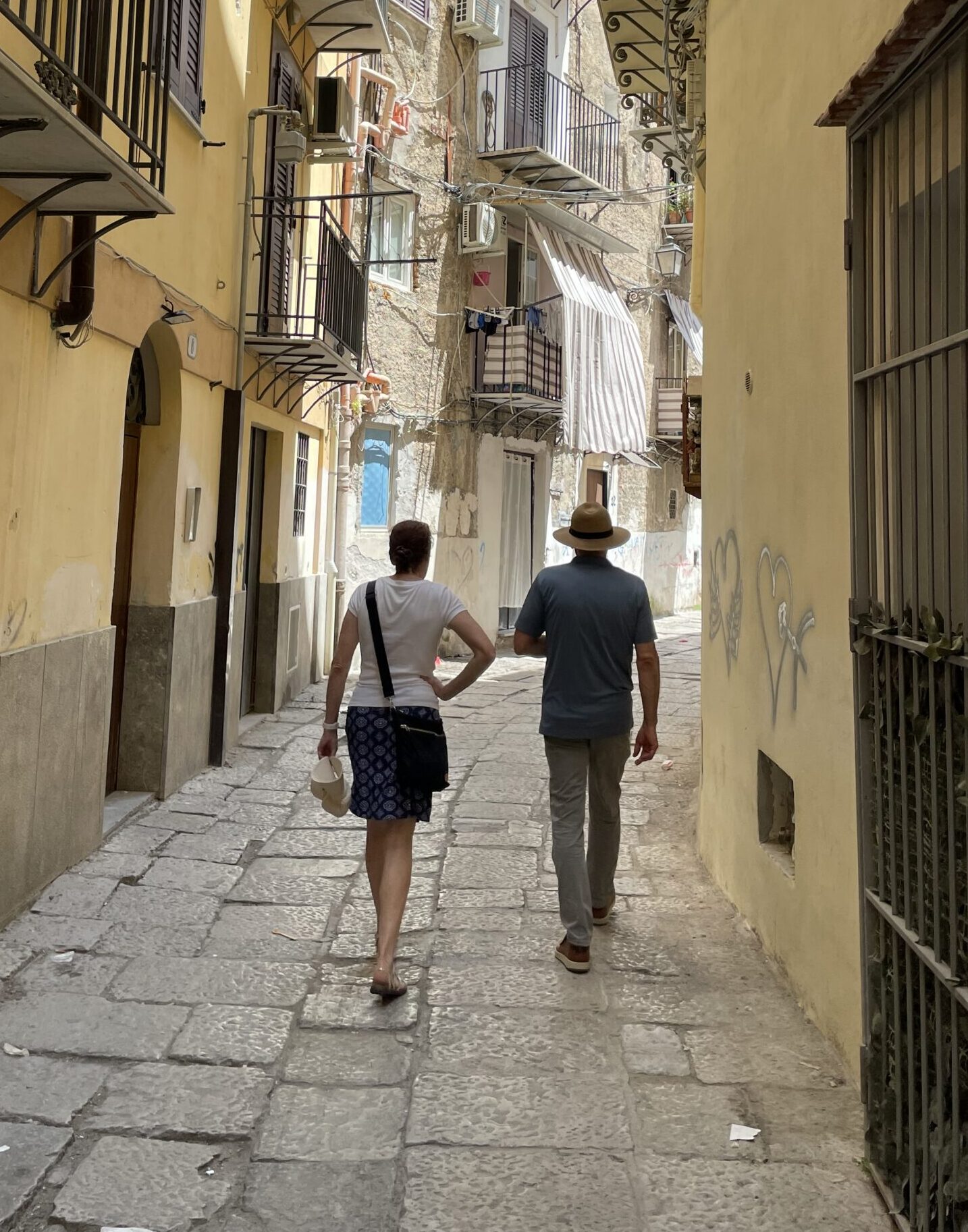
British social anthropologist Tim Ingold takes this approach in the phenomenological direction by applying it to how humans move through the world together. He argues for an anthropological practice centered around learning with people, or “walking alongside” them.
More specifically, he sees “walking alongside” as an embodied praxis that fundamentally changes the relationship people have with one another. In short he argues that it creates:
- Shared Orientation: Unlike a sit-down interview where you look at someone (creating an interrogative dynamic), walking alongside means you are both looking forward at the same landscape. You see what they see, when they see it.
- Attunement: To walk with someone, you have to match their pace, navigate the same obstacles, and experience the same sensory environment (the weather, the terrain, the noise). Ingold calls this “attunement”—a shared bodily experience that creates deep, non-verbal alignment.
At this point, I hear you thinking: “Wow, he sure took the long way around to say that we need to go on more walks together.” You’re right. Thanks for hanging in there!
But I pulled “speaking nearby” and “walking alongside” into this post because they set a productive foundation for open thinking and appreciating the importance of imagined possibilities. They can become part of a critical platform for learning that is inherently distinct from rigid adherence to a singularly-focused practice. They go beyond the scope of interview protocols or design exercises (which often feel like tests to participants), to invite mutual daydreaming at an intimate level. They seek imaginings in co-defined context, not answers framed within only the practitioner’s context. Given enough room to cultivate, stories from within speaking nearby or walking alongside can inspire new forms of interpretation, hybrid methods, or other approaches that are tailored to the challenge at hand and the organization we’re serving.
In sum, I’m advocating for a form of adaptive mixed methods with a deep appreciation for mini-narratives, incremental realizations, and symbolic meanings that are embedded and evolve within them. For example, after a bit of walking alongside, we may find that our research approach would benefit from a survey, or a horizon scan, or participatory observation. etc. Or, if we’re lucky, we may have also formed a new bond with a participant that led to mutual discovery.
I’ll close with a couple of clips, each of which reveals the higher order of meaning that can emerge from walking alongside, but with very different results!
Discover more from Ethnographic Mind
Subscribe to get the latest posts sent to your email.
Leave a comment